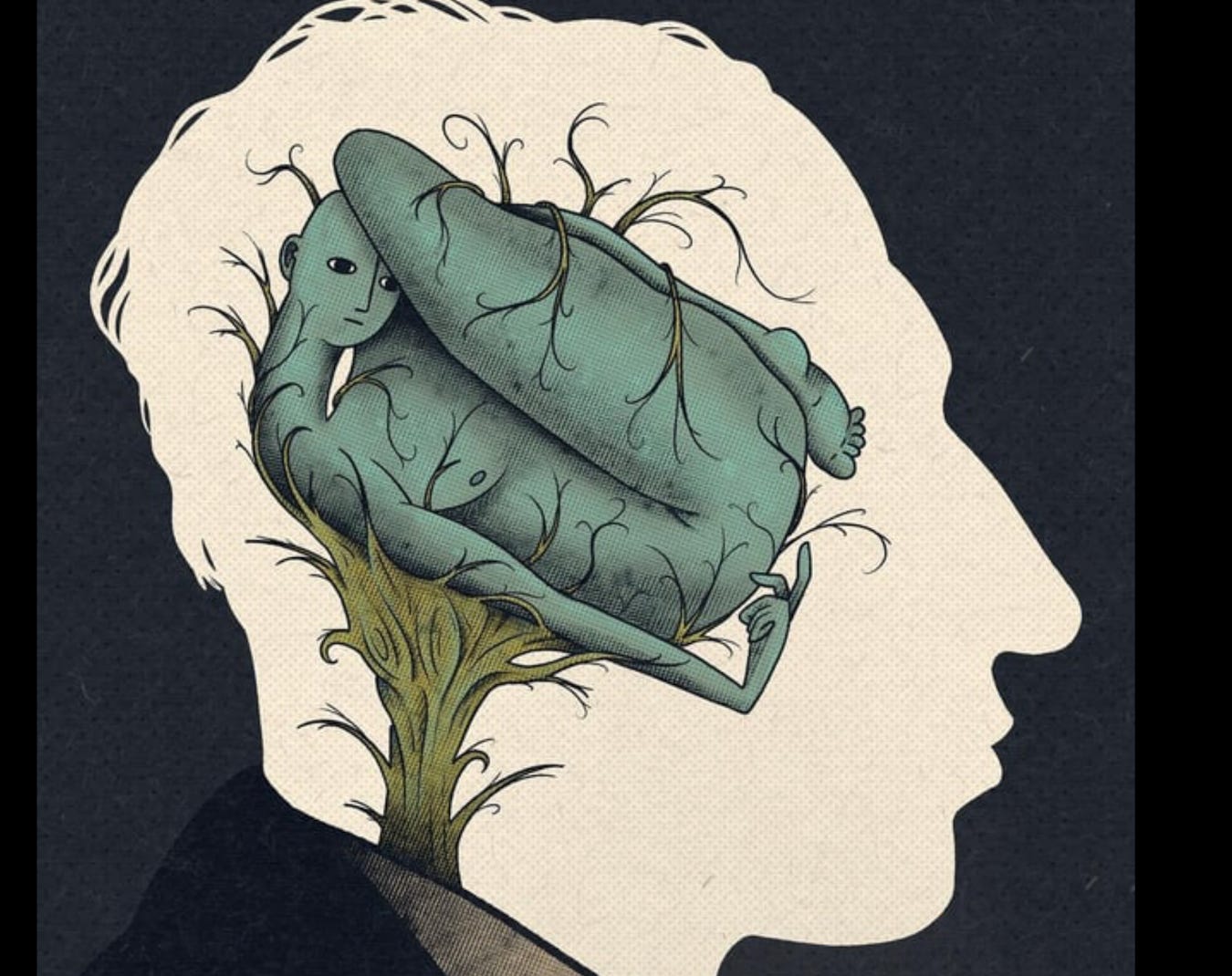
The world began with events no one was around to name or justify. People arrived, and wherever they gathered, culture appeared, bringing a set of silent rules about how a person is supposed to live. Refusing those rules, for whatever reason, is usually where conflict starts.
Before gods in courtyards or politicians on loudspeakers, there were only gradients flattening, energy dispersing, matter collecting into brief forms that did not know they were brief. Stars burned, collapsed and scattered heavy elements without needing a story. For a second on the cosmic time scale, on one small planet in one corner of this process, human nervous systems emerged that could not bear to live inside structure alone. They wrapped it in myths, rituals and moral frameworks that made it feel less like blind mechanics and more like a conversation. Some of those stories softened suffering or stabilised cooperation; others hardened into tools for control.
Growing up in a place thick with superstition and social surveillance, it is hard not to feel the tension between that indifferent process and the very interested humans clinging to it. There is the physics of weather, and then there is the village gossip about why the storm came when it did. The gap between those two explanations is where a certain kind of mind begins to fracture, then sharpen (hopefully).
From inside a rural town, the universe first appears as other people’s certainty. Illness is karma, misfortune is evil eye, dissent is arrogance, authority is the natural order of things and whatnot. Every event arrives pre-wrapped in narrative, as if causes matter less than the comfort of already knowing whom to blame. Yet under the rituals and warnings, the same architecture that runs black holes runs bus schedules and family arguments. Rain falls because clouds reach saturation, not because someone skipped a prayer; crops fail because of soil, policy and markets, not because a neighbour offended a god. Follow the spine of cause and effect far enough and the explanations that survive look less like morality plays and more like physics plus history. Another layer appears too: the desperation for control beneath all the faith, the human urge to make reality obey how it feels. Seeing this does not free anyone on its own; it just closes some of the older exits. If there is no clause where a soul steps outside the chain, there is also no tunnel where the chain steps outside itself to reward or punish. The world stays exactly as harsh and as soft as its conditions allow.
In a tight culture where neighbours feel licensed to question your clothes, beliefs, friends and future plans, where every minor gesture is scanned, and where even your childhood caretakers outsource your worth to the crowd; hyper-awareness starts as defence. The body tunes itself to micro-signals: a shift in a relative’s tone, a teacher’s expression, a local leader’s joke about modern kids that is not really a joke. From the outside this looks like anxiety; from the inside it is a constant scan for where the next demand for obedience will appear. Although even this vigilance is part of the same process, a pattern of neural responses sculpted by years of small threats and humiliations. Nothing mystical is needed. The same architecture that moves heat from hot to cold pushes a child toward behaviours that minimise social pain. Once hyper-awareness turns inward, it starts to examine not only faces and rooms but the stories themselves. Why does every explanation point away from structure and toward sin, destiny or tradition. Why do those explanations always stabilise the power of the people using them.
Religious dogma and superstition can look, in kinder moods, like ancient compression algorithms. Faced with an unmanageably complex world, communities distilled countless causes into simpler narratives: storms as divine anger, illness as moral failure, prosperity as blessing. These shortcuts helped coordinate behaviour and reduce terror when no one had access to climate science, epidemiology or economics. Compression has a cost. What gets lost is the actual structure, the material, political and historical chains that generate the suffering in the first place. Once a pattern of harm is labelled God’s will or how our culture is, it becomes harder to treat it as something that could, in principle, be re-engineered. From the process’s perspective, belief itself is just another node, neural circuits tuned to stories that survived because they offered cohesion and comfort. From inside a questioning mind, the same structure feels like a cage disguised as shelter. To refuse a ritual is to risk being read as refusing the people who rely on it for identity.
Authoritarian behaviour in such settings is not a glitch; it is one way the system preserves its own coherence. When a father cannot be questioned, a teacher cannot be corrected and a politician cannot be mocked, information stops flowing where it most threatens existing gradients of status. The chain here takes a social form: patterns of deference and fear that keep certain nodes insulated from feedback. Religious rhetoric often supplies the vocabulary that justifies this insulation, so pushing back against a rule is framed as disrespecting elders, betraying the community or rebelling against divine order. Metaphysical claims about souls and dharma become tools for silencing the physics of who is harmed, who benefits, what actually changes. Structurally, these arrangements are fragile. They depend on constant narrative maintenance, on media that never ask certain questions, on schools that teach obedience more carefully than reasoning, on families that confuse love with control. Every insistence that this is just how it is is also a sign that it could have been otherwise.
In a world where everyone feels entitled to your story, demanding privacy looks like a glitch. Saying no to a casual interrogation about religion, romance or migration is treated as abnormal, even rude. From a chain-and-node perspective, opacity is not indulgence; it is insulation for any mind trying to update its models without constant external interference. If every half-formed doubt must be defended immediately to family, neighbours or strangers online, most people will stop allowing themselves new doubts. They retreat into already accepted stories because questioning them in public is too costly. The architecture then settles around inherited myths, not because they are true, but because they are cheaper to carry. A room of one’s own is not just a slogan; it is a local modification of boundary conditions. Inside that boundary, a nervous system can run simulations, reconsider loyalties and experiment with new interpretations without instant punishment. The chain still runs through that room, but the local pattern has more time to reconfigure before it collides with the larger culture.
Turn on the regional news and the chain becomes a blur. Isolated scandals appear and vanish, religious tensions are described as unfortunate misunderstandings, development projects are celebrated with little interest in who actually benefits. The result is an information diet heavy on events and light on structure. A structural mind looks for links: how media ownership shapes coverage, how identity politics diverts attention from economic concentration, how spectacle replaces accountability. Most broadcasts treat each day as a fresh start that requires no memory of the last hundred similar days, so time becomes an endlessly shuffled playlist instead of an ordered chain. Some people numb out; others look for alternative sources that at least attempt deeper context. Selective attention becomes an ethical act, a refusal to let one’s limited bandwidth be colonised entirely by noise, brains triaging inputs to preserve some capacity for coherent modelling.
In such a landscape, the fantasy of leaving, to another city, another country, another culture, feels almost structural. If the local chain has settled into patterns that punish autonomy and reward conformity, perhaps a different environment will support different nodes. Relocation becomes less about income and more about escaping specific configurations of expectation and shame. But architecture travels. The same tendencies toward narrative comfort, charismatic authority and moral panic exist elsewhere too, only dressed in new symbols, and the old fear of judgement can be carried into a city where no one knows your name. The more radical form of leaving begins before any ticket is booked. It starts when a mind stops granting metaphysical status to the stories that once governed it and accepts that even this refusal is just one more rearrangement in a causal chain, yet still chooses, from inside the experience, to side with clarity over comfort.
When older illusions crack, about free-floating souls, divine plans or leaders chosen by destiny, there is a period where the world feels less coherent. The old answers are gone and nothing has yet replaced them. Some people try to glue the narratives back together; others sink into bare, unstructured despair. The absence of supernatural coherence does not mean the absence of structure. The chain is still there, indifferent and complete, running through migration, protest, kindness, corruption, art and boredom. What changes is not the architecture but the model built inside it, and the emotional price one is willing to pay for accuracy. A different coherence becomes possible, one that does not pretend we stand outside causation. Responsibility becomes a local tool for shaping futures, not a cosmic property attached to souls, and ethics becomes a kind of engineering under uncertainty: adjusting laws, norms and distributions so that fewer configurations include preventable suffering.
In this view, a person is not an author perched above reality but a node through which the chain briefly folds back on itself. Consciousness is the architecture modelling a small part of its own dynamics and misreading that act as independence. The feeling of I could have done otherwise is what limited access to causes feels like from the inside. Yet within that illusion, words are written or left unwritten, hands are held or withdrawn, laws are passed or resisted, myths are repeated or questioned. Each of these is a different trajectory through the same architecture, with different downstream configurations of joy, harm, silence or revolt. The cost of this coherence is the loss of older comforts: no secret exemptions, no miracles on demand, no metaphysical court of appeal. What remains is a harder dignity, to see the lock clearly and still care what happens inside the room. The chain moves, you move with it, and inside that inevitability there is still the live question of what kind of pattern you will allow to pass through your node. Or perhaps, that’s my idealism talking. But why does it matter? Because at the end, seeing a diluted view of reality in people with a stronger voice than mine, for whatever reason, still makes my skin burn.